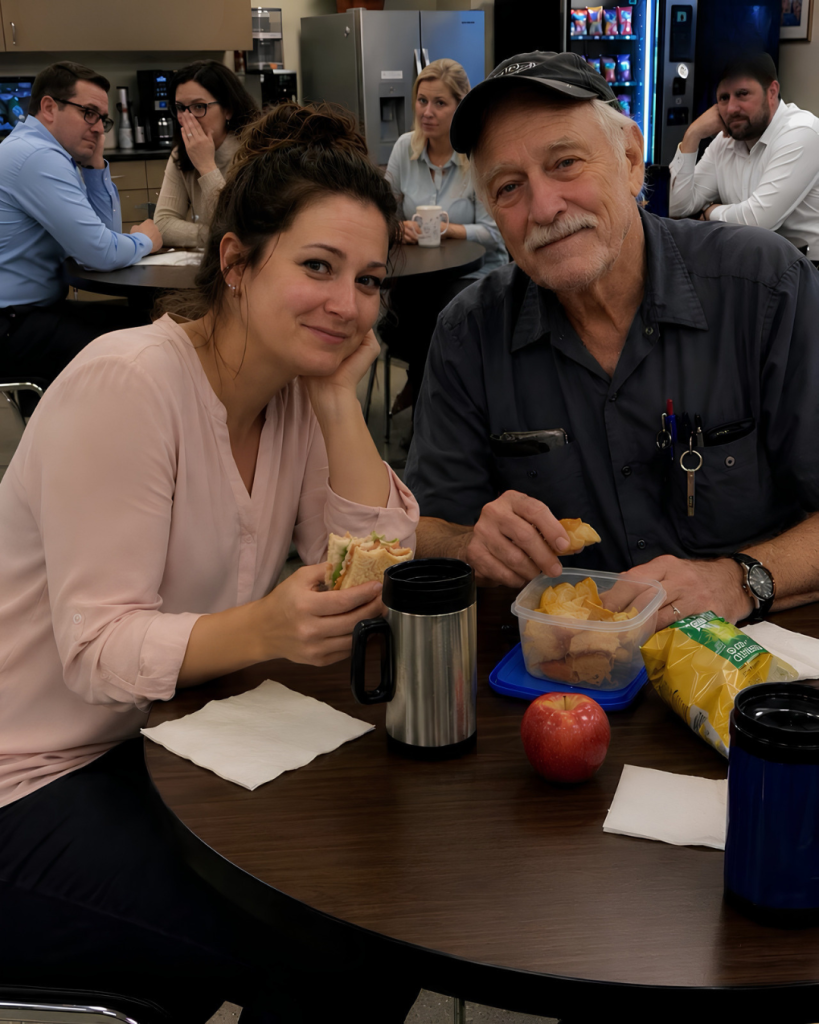

The Janitor Everyone Ignored Changed My Life Forever
On my first day at work, I was too nervous to eat my lunch.
I had arrived early, met my manager, smiled through introductions, and tried my best to fit in. By noon, however, I felt completely out of place.
The break room was crowded with laughter and conversations. Everyone seemed to already have their own groups, their own inside jokes, their own place to belong.
I stood there holding my lunch, wondering where I could sit without feeling like an intruder.
That’s when I noticed him.
Near the window sat an older man in a gray maintenance uniform. He looked up from his sandwich and gave me a small smile.
“You can sit here if you’d like,” he said.
Relieved, I thanked him and sat down.
“My name’s Charlotte.”
“Charles,” he replied.
That simple invitation changed both of our lives.
The next day, I sat with Charles again. Then the day after that. Before long, lunch at noon became our routine.
For eleven years, we shared the same table.
We talked about ordinary things—books, weather, broken elevators, weekend plans. Nothing extraordinary, yet somehow those conversations became one of the most meaningful parts of my day.
Charles was quiet, thoughtful, and kind. He never demanded attention and never complained. While others rushed through life, he seemed to understand the value of simply being present.
Unfortunately, not everyone understood our friendship.
Some coworkers joked about me eating lunch with “the janitor.” Others teased me for spending time with someone they considered beneath them.
I laughed off the comments, but they still stung.
Charles never seemed bothered.
One day I asked him why.
He smiled and said, “People are loudest when they don’t understand what quiet is worth.”
At the time, I didn’t fully grasp what he meant.
Years passed.
When I earned a promotion, Charles celebrated by buying me a cupcake from the gas station down the street.
When my marriage fell apart, he sat with me through the silence without asking questions.
When my mother died, he quietly split his sandwich in half and pushed part of it toward me.
“Eat something,” he said. “You’ll feel worse if you don’t.”
He never tried to solve my problems. He simply showed up.
And somehow, that was exactly what I needed.
Then one Monday, Charles wasn’t at our table.
Neither was he there on Tuesday.
Or Wednesday.
On Thursday, I learned why.
Charles had died over the weekend from a heart attack.
The news hit me harder than I could have imagined.
The break room was as loud as ever, but our table sat empty.
And for the first time in eleven years, I ate lunch alone.
That Saturday, I attended his funeral.
None of my coworkers came.
Only a handful of people sat in the chapel.
After the service, a man approached me.
“Are you Charlotte?” he asked.
When I nodded, he introduced himself as Charles’s attorney.
“He left something for you.”
He handed me an old shoebox.
Inside were dozens of photographs.
The first one stopped me cold.
It was me.
My first day at work.
Then another photo.
And another.
Pictures from my promotion, my divorce, difficult days, happy days, ordinary days.
Charles had quietly documented eleven years of my life.
At the bottom of the box was a worn notebook—the same notebook he used to write in every day after lunch.
I opened it.
Inside were hundreds of short entries.
“Charlotte smiled today. First time all week.”
“Promotion day. She pretended it wasn’t a big deal. It was.”
“Her mother is gone. Ask tomorrow if she slept.”
Page after page, year after year.
Every moment I thought nobody noticed, Charles had noticed.
Every struggle I thought I carried alone, he had quietly carried alongside me.
Then I found a letter.
In it, Charles wrote that he had once had a daughter.
She had died many years earlier.
Life had never felt quite the same afterward.
Then, on my first day at work, I sat down across from him.
He said I reminded him of her—not in a painful way, but in a way that brought warmth back into his life.
He never told me because he didn’t want me to feel responsible for his happiness.
Near the end of the letter, a photograph slipped out.
It showed a young woman standing beside Charles.
For a moment, I thought I was looking at myself.
I turned it over.
Written on the back were two simple words:
My daughter.
With trembling hands, I continued reading.
The final line shattered me.
“Everyone thinks I gave you a seat at my table,” he wrote. “The truth is, you gave me one.”
The following Monday, I carried the shoebox into the break room.
When someone casually mentioned that I’d attended “the janitor’s funeral,” I stopped them.
“His name was Charles,” I said.
Then I opened the box.
I showed them the photographs.
The notebook.
The years of memories.
The room slowly fell silent.
For the first time, people saw what I had always seen.
Not a janitor.
Not a background figure.
A human being who had quietly touched countless lives.
I sat down at our table one last time.
Charles’s chair remained empty.
But it no longer felt like an absence.
It felt like a reminder.
A reminder that the smallest acts of kindness often leave the deepest marks.
On my first day at work, Charles offered me a chair.
It took me eleven years to realize that what he really offered was friendship, understanding, and a place to belong.
And in the end, he taught me a lesson I’ll never forget:
The people the world overlooks are often the ones who have the most to give.