
Here’s a rewritten version of your article with a smoother, more emotional narrative flow while preserving the heart of the story:
There were countless nights when sleep never came.
Nights when I stared at the ceiling, wondering if I was doing enough. If I had said the right things. If I had missed something important.
I often wondered whether love alone could make up for everything I didn’t know.
Looking back now, I realize that the life I built began on one ordinary October evening—the night I came home exhausted and nearly tripped over three car seats sitting on my porch.
The porch light flickered weakly, casting a pale yellow glow across the worn wooden boards. I had just finished a double shift at the hardware store and was already reaching for my apartment keys when I saw them.
Three infant car seats.
A diaper bag.
And a note written on the back of a gas station receipt.
For several seconds, I simply stood there, unable to process what I was seeing. Finally, I picked up the note.
The handwriting belonged to my younger brother, Daniel.
“I’m sorry, Noah. I can’t do this.”
That was it.
No explanation. No phone number. No clue where he had gone.
Daniel’s wife, Patricia, had died only eleven days earlier. Less than two weeks after burying her, my brother abandoned the three daughters she left behind.
At twenty-seven, I was single, living in a tiny apartment above the hardware store where I worked. I had just over three hundred dollars in my bank account, a broken futon, and absolutely no idea how to care for a baby.
Much less three.
A soft hiccup pulled me from my thoughts.
Two of the babies slept peacefully, but the smallest was awake, staring up at me with gray eyes that looked exactly like our mother’s.
“Hey there,” I whispered.
Just then, my neighbor, Mrs. Hunter, stepped outside in her bathrobe.
“Noah?” she asked, alarmed. “What on earth happened?”
I handed her the note.
After reading it, she looked from the paper to the babies, her expression filled with shock and concern.
“Honey,” she said gently, “you can’t raise three babies by yourself.”
“I know.”
“You don’t even know how to warm a bottle.”
“I know that too.”
She sat beside me on the porch.
Honestly, I was ready to agree with her. I was prepared to call social services, convinced there had to be families far more qualified than I was.
Then the smallest baby reached out.
Her tiny fingers wrapped around my index finger.
I froze.
“Patricia always said the smallest one would be named June,” Mrs. Hunter whispered.
“June,” I repeated softly.
June didn’t know I was broke. She didn’t know I’d never changed a diaper or held a newborn for more than a few minutes. She didn’t know her father had left her on a porch.
She only knew that someone was there.
Mrs. Hunter spoke carefully.
“I’ll contact social services in the morning. There are wonderful families who can take care of them.”
I started to say yes.
Instead, I looked down at June’s hand holding mine and whispered, “I’ve got you.”
That night, I carried each baby inside.
Somewhere between the second trip and the third, I stopped being Uncle Noah.
I became their father.
The years that followed weren’t easy.
I burned breakfasts, packed lunches with the wrong bread, learned to warm bottles, check fevers, and braid hair—badly. Mrs. Hunter often had to redo the girls’ hairstyles before school.
I worked double shifts, sometimes triple, to keep food on the table and pay for braces, school supplies, and shoes that seemed too small only weeks after buying them.
There were sleepless nights spent beside sick beds.
School plays where I applauded louder than anyone else.
Heartbreaks I couldn’t fix, so I made grilled cheese sandwiches and sat quietly beside my daughters while they cried.
There were difficult years, too.
At thirteen, June slammed doors.
At fifteen, Claire refused to speak to me for nearly a month.
At seventeen, Ava insisted I didn’t understand anything.
She was right.
I didn’t.
But I stayed.
I missed weddings, canceled long-awaited trips, and gave up dreams I once thought mattered.
I even lost Diana.
Diana was the woman I loved.
One evening, standing at my front door, she asked, “I’m not asking you to choose, Noah. I’m only asking if there’s room for me.”
I looked down the hallway toward three half-open bedroom doors.
“There isn’t,” I admitted. “Not the kind of room you deserve.”
She nodded sadly, as though she’d known the answer all along.
She left that night.
I still kept the sweater she forgot.
Daniel occasionally resurfaced over the years—birthday cards without return addresses, Christmas cards from unfamiliar cities.
When the girls turned twelve, he called.
“I want to reconnect,” he said. “I’ve been thinking about being their father.”
I gripped the phone tightly.
“If you want to be their father,” I replied, “buy a plane ticket. Don’t tell me about it over the phone.”
He never came.
Eventually, even the cards stopped.
Late at night, after the girls were asleep, doubts often crept in.
Had I done enough?
Did they know how much I loved them?
Or would they always be waiting for their real father?
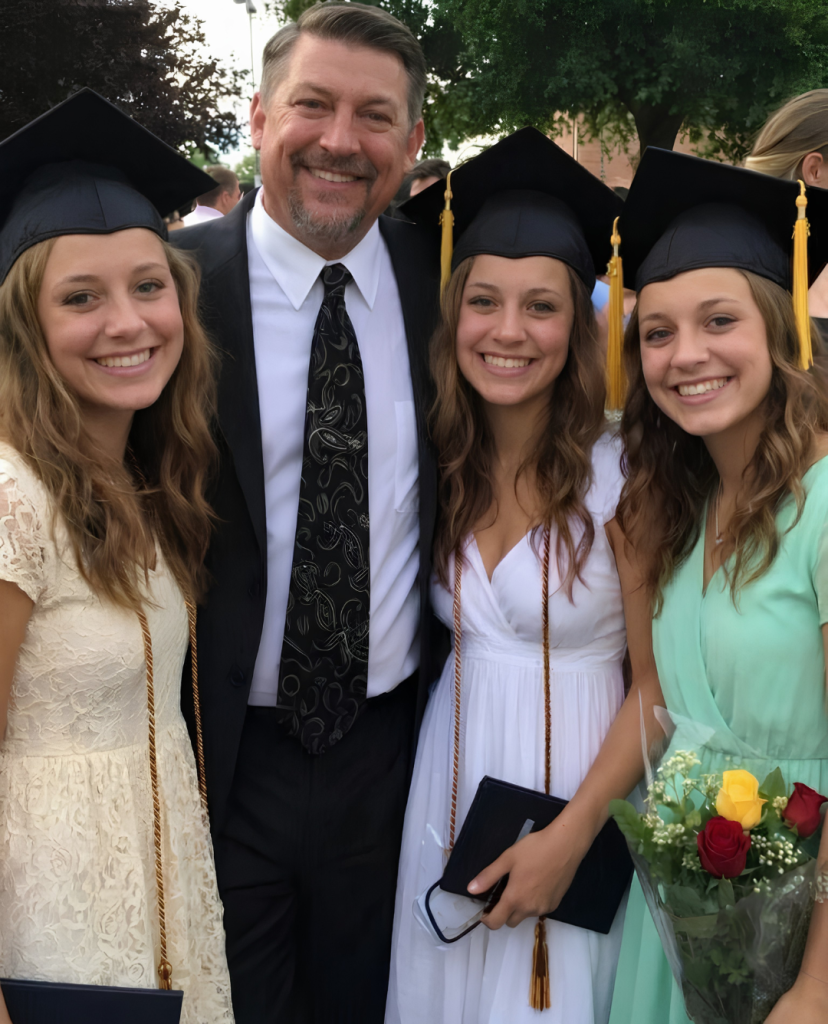
Their college graduation arrived before I was ready.
Sitting alone in my truck outside the auditorium, I found myself holding the same faded note Daniel had left on my porch twenty-two years earlier.
“I’m sorry, Noah. I can’t do this.”
I wondered if my daughters still wished he had come back.
Inside the auditorium, I sat seven rows from the stage, nervously clutching a cheap camera.
One by one, my girls crossed the stage.
Ava cried as she accepted her diploma.
Claire waved enthusiastically from the stage, just as she used to from the school bus.
Then came June.
Quiet and composed, as always.
I thought the ceremony was over when the dean returned to the microphone.
To my surprise, all three girls walked back onto the stage together.
June stepped forward.
“Our father couldn’t be here today,” she began.
My heart sank.
They were going to talk about Daniel.
After everything, I wanted them to have whatever peace they needed.
Then June continued.
“We found the notebook in the kitchen drawer.”
My breath caught.
The notebook.
The one where I’d secretly written letters to them over the years.
June began reading.
“To my girls: You’re one year old today. I don’t know if you’ll ever read this, but I need you to know something. I’m scared all the time. I don’t know how to be a father, but I’m not going anywhere.”
I recognized every word.
I had written them at a small kitchen table above a hardware store while three babies slept nearby.
June looked directly at me.
“I may never be the father you deserve, but I’ll always be the one who shows up.”
Ava continued through tears.
“I promise you’ll never have to wonder where I am.”
Claire read the final line.
“I love you more than I ever knew it was possible to love.”
By then, I was crying too hard to see.
June stepped down from the stage and placed a framed document in my hands.
“We filed the paperwork months ago,” she whispered. “The adoption became official last week.”
I looked down at the papers through blurred vision.
Ava turned back to the audience.
“Noah was never just our uncle,” she said.
Claire smiled through tears.
“He has always been our dad.”
The entire auditorium rose in applause.
A few weeks later, I stood in my apartment and hung two frames side by side.
On the left was Daniel’s faded note.
On the right were the adoption papers.
For years, I had thought of my life as a sacrifice.
Standing there, I finally understood the truth.
It wasn’t a sacrifice.
It was a choice.
The greatest one I ever made.
And somehow, along the way, that life chose me too.
That evening, I picked up my phone and scrolled to a number I hadn’t called in twelve years.
Diana.
Before I could change my mind, I pressed call.
She answered on the second ring.
“Hello?”
For a moment, neither of us spoke.
Then she softly said, “Noah?”
I smiled.
“Hi, Diana.”
“Is everything okay?”
I looked toward the wall where the two frames hung side by side.
For the first time in years, I answered honestly.
“Yeah,” I said. “I think it finally is.”